
What's inside
- Best Phone Microphone for Street Interviews: Lavaliers, Wind, and Two-Voice Kits
- Best Phone Microphone for Street Interviews: Quick Comparison
- The Six Street Interview Microphone Systems Reviewed
- Buying Guide: How to Choose and Use the Best Phone Microphone for Street Interviews
- Frequently Asked Questions About Phone Microphones for Street Interviews
As an Amazon Associate I earn from qualifying purchases. This post may contain affiliate links at no extra cost to you.
The best phone microphone for street interviews solves the street’s specific cruelty: your subject is interesting, your phone’s camera is excellent, and your audio is a traffic report with a voice buried in it, because the phone’s built-in microphone is an omnidirectional ear sitting a meter and a half from the speaker, faithfully recording the bus, the wind, and the crowd at the same level as the answer you actually wanted. The fix is to move the microphone to the voice, a wireless lavalier clipped to the subject’s collar, twenty centimeters from the source, where the voice suddenly outweighs the street by physics rather than by hope. This guide grades six real, currently sold phone microphone systems for street interview duty specifically, wireless lavalier kits first, since they own the format, with the handheld and shotgun alternatives honored where they serve better, on the criteria that decide a usable clip: voice isolation in real noise, wind handling, the two-person kit’s completeness, since an interview has two voices and the question matters too, battery and charging in the field, and the monitoring and gain controls that keep a loud answer from clipping into uselessness. It closes with a buying guide that runs the interview like a professional, levels checked, wind managed, consent and courtesy observed, because the street grades the operator as harshly as the equipment.
Learn the street’s audio physics in one paragraph, because it explains every row below. Sound falls with distance, so halving the microphone’s distance to the mouth buys more clarity than any processing at any price, which is the lavalier’s whole argument and the reason a thirty-dollar lav at the collar beats a three-hundred-dollar shotgun at the camera on a noisy corner. Wind is the second physics: moving air across a microphone’s diaphragm is noise at the source, answered by foam and, decisively, by the furry windshield, the dead cat, whose absence from a kit should be treated as an incomplete product for outdoor work. The third is dynamic range: a subject who whispers the setup and laughs the punchline will clip a fixed-gain recording into distortion, so automatic gain, limiters, and, in the better kits, 32-bit float recording or a safety track at a lower level, are the difference between an answer that survives its own enthusiasm and one that must be subtitled in apology. Grade the table by those three physics, and the marketing, range figures measured across empty fields, battery figures at idle, will sort itself into the fine print where it belongs.
Our Top Picks
Best Phone Microphone for Street Interviews: Lavaliers, Wind, and Two-Voice Kits
Why Wireless Lavaliers Own the Street Interview
The lavalier kit’s completeness for this format is structural: two transmitters, one for the interviewer and one for the subject, clipped in seconds without a sound check’s ceremony, each voice on its own channel or its own file in the better systems, so the edit can balance a soft-spoken subject against an exuberant host. The subject forgets the microphone within a sentence, which is the format’s secret, the natural answer being the product of a forgotten microphone and a remembered question. The receiver plugs into the phone’s USB-C or Lightning port, or connects by the phone’s Bluetooth in the newest class, and the whole kit lives in a charging case in a jacket pocket, deploying faster than a tripod. Its honest limits are the street’s: radio interference in the densest spectrum jungles, range that is a plaza’s rather than a stadium’s, and a visual signature, the clipped box and its wire’s descendant, that some productions dress with magnetic mounts and concealing placements the steps will mention. For the solo creator and the small crew, it is not the budget option but the professional one that happens to have become affordable, a distinction the table’s prices now make vividly.
Wind, Gain, and the Safety Track: The Field Recording Trinity
Outfit and configure for the three failures that ruin street audio. Wind first: furry windshields on both transmitters, always, outdoors, the foam alone being a fair-weather promise; the lav placed under a collar’s or a jacket’s shelter where the subject’s clothing allows, since placement is a windshield that never falls off; and the interview positioned with the subject’s back to the wind where the corner’s geography permits, the oldest trick in location sound and still the cheapest. Gain second: set levels by a test sentence at the subject’s loudest expected laugh, not at their polite hello, aiming for peaks safely below clipping in the app’s meter where one is shown, with the kit’s automatic gain or limiter engaged as the second line rather than the first. The safety third: where the system offers 32-bit float, which records a dynamic range so wide that clipping is nearly impossible and levels are set in the edit, or a dual recording with a safety track at reduced gain, use it, since the street offers no retakes of the unrepeatable answer, and storage is cheaper than regret. The steps will run this trinity as a pre-interview ritual of ninety seconds, which is the entire difference between the amateur’s luck and the professional’s consistency.
Consent, Courtesy, and the Law of the Street
A street interview is a recording of another person, and its ethics and law deserve a section rather than a footnote. Consent is the working rule: approach openly, identify yourself and the microphone’s presence, since the lav is visible anyway, and take a clear yes for the record, ideally captured at the clip’s head, which protects the production and respects the subject in one gesture. The law varies, public-space filming being broadly permitted in many places while audio recording consent rules divide jurisdictions into one-party and two-party regimes, and commercial use adds releases and the property rules of malls, stations, and events, all of which the working creator checks for their own patch rather than trusting any guide, including this one. Courtesy is the craft’s other half: the interview that ends with thanks, a card or a handle where the piece will appear, and the subject’s dignity intact through the edit, is the one that gets the next subject to stop, since the street watches how you treat the last person before it decides whether you may approach the next. Equipment serves that reputation or spends it, and the guide’s steps close the loop accordingly.
Best Phone Microphone for Street Interviews: Quick Comparison
| Phone Microphone System | Key Specs | Best For | Typical Price Range | Rating |
|---|---|---|---|---|
| DJI Mic 2 (2 TX + 1 RX + case class) | Wireless lav kit in class, 32-bit float internal recording positioning in line, noise cancelling in class, charging case | Best phone microphone for street interviews overall | $270 – $350 by kit | 4.8 / 5 |
| Rode Wireless GO II / ME class | Wireless lav kits in class, onboard recording in line in GO II, established ecosystem | Best established alternative | $200 – $300 by kit | 4.6 / 5 |
| Hollyland Lark M2 / Max class | Compact wireless lavs in class, button-size transmitters positioning in line, noise cancelling in class | Best discreet and value pro | $130 – $300 by model | 4.5 / 5 |
| DJI Mic Mini class | Ultralight transmitters in class, direct phone connection positioning in line, case kit | Best ultralight kit | $140 – $180 | 4.5 / 5 |
| Boya / Maybesta budget wireless lav class | Plug-and-play phone lavs in class, single and dual kits in line, very low price | Best rock-bottom budget | $25 – $60 by kit | 3.9 / 5 |
| Rode VideoMic Me / NT-USB Mini class alternatives | Directional phone shotgun in class (VideoMic Me), for single-voice pieces | Best handheld/shotgun alternative | $60 – $130 | 4.2 / 5 |
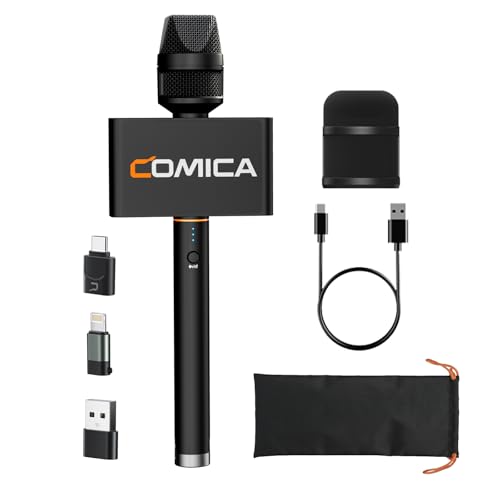
COMICA Revo S Wireless Handheld Microphone for iPhone17/16 Android Phone PC | Professional Interview Microphone with Plug & Play, Noise Reduction, Reporter Mic for Content Creators Speech Podcast Vlog
As an Amazon Associate we earn from qualifying purchases. Product prices and availability are accurate as of the date/time indicated.

Mini Mic Pro (Latest Model – #1 Microphone for iPhone & Android, Wireless Mini Microphone, Clear Voice, Noise Cancelling, Lavalier Mic for TikTok, YouTube & Interviews
As an Amazon Associate we earn from qualifying purchases. Product prices and availability are accurate as of the date/time indicated.

4-in-1 Mini Mic &Desk Stand,Interview Handheld Wireless Lavalier Microphone | Phone Microphone for iPhone/Android/Tablets/PC,Mini Mic with Charging Case for Podcast ,Streaming
As an Amazon Associate we earn from qualifying purchases. Product prices and availability are accurate as of the date/time indicated.
Prices shown are approximate and for reference only. Prices change often, so please check the current price on Amazon before you buy.
Recording features and compatibility summarize manufacturers’ published information for current versions; confirm your phone’s port and the kit’s receiver type. Ratings are editorial, weighing voice isolation in noise, wind readiness, two-voice completeness, gain safety, field battery, and value.
The Six Street Interview Microphone Systems Reviewed
1. DJI Mic 2: Best Overall
The Mic 2 leads because it answers the street’s trinity completely: transmitters that record internally in 32-bit float, making the unrepeatable answer nearly unclippable; intelligent noise cancelling that takes the traffic’s edge off without the underwater artifacts of lesser processing; a charging case that keeps the two-transmitter kit ready in a pocket; and a build and screen that a working creator can run by touch between subjects. Its price is the professional class’s, and for the channel whose audio is its reputation, it is the recommendation this guide defends, the kit whose failures, in a season of corners, will be the operator’s rather than the equipment’s, which is the definition of professional gear.
2. Rode Wireless GO II: Best Established Alternative
Rode’s GO II is the system a generation of creators standardized on: two transmitters with onboard recording as the safety track, a mature app and ecosystem of lavalier accessories, magnetic mounts, and furry windshields sized to it, and a sound that editors know. Its transmitters are larger than the newest minis and its float recording is the safety-track kind rather than the DJI’s 32-bit, distinctions its price and its ecosystem answer. The ME class below it serves the phone-first buyer in the same house. For the creator buying into the deepest accessory bench in the category, it remains a first-rank choice, and its rating reflects a platform whose street record is written in a million published interviews.
3. Hollyland Lark Class: Best Discreet and Value Pro
Hollyland’s Lark line competes on the transmitter’s size and the kit’s price: transmitters in the button class that disappear on a collar, noise cancelling in the line’s specification, and kits, M2 for value and Max for the flagship features, that undercut the leaders while keeping the format’s essentials. Its ecosystem is younger, its windshields and mounts should be confirmed in the box or budgeted as the steps direct, and its sound has won it a following that its price alone cannot explain. For the discreet production, the journalist’s low profile, and the budget that wants the professional form without the flagship’s tariff, it is the value-pro row, graded closely behind the leaders it is visibly hunting.
4. DJI Mic Mini: Best Ultralight Kit
The Mic Mini distills the leader’s philosophy into transmitters of a few grams that a subject forgets before the first question ends, with direct connection options in its class and a case kit that lives in a coat pocket without negotiation. It concedes the flagship’s float recording and screen, keeping the essentials, clean gain, noise handling in its class, and the two-voice completeness. For the run-and-gun creator whose kit is already a negotiation with a small bag, and for subjects, children, the elderly, the formally dressed, on whom a standard transmitter is a presence, it is the considerate row, and its rating reflects how completely it serves the interviews where the microphone should be the least interesting object in the frame.
5. Budget Plug-and-Play Lav Class: Best Rock-Bottom
The budget wireless lavs, Boya’s and a dozen storefront brands’, deliver the format’s founding miracle, a lav at the collar for the price of a team lunch, with a receiver that plugs into the phone and simply works in quiet rooms and gentle streets. Their limits are the street’s examination: processing that swims in real noise, windshields absent or token, gain fixed at a hope, and build that treats the season as a rumor. Graded as the entry drug and the backup kit, they are honestly serviceable, and many channels’ first fifty interviews were recorded on exactly this class; graded as the street’s professional tool, they are the tuition whose payment argues for the rows above, a distinction this guide states once and applies everywhere.
6. Rode VideoMic Me Class: Best Directional Alternative
The phone shotgun serves the interview’s other grammar, the single voice addressed to the camera, the reporter piece, the vox pop where the microphone itself, visible and directional, is part of the format’s language and a handheld presence the subject speaks into. Its directionality rejects the street’s sides while its distance, the phone’s length, keeps the physics’ tax the lav avoids, and its wind performance with its furry cover is the class’s honest work. For the creator whose interviews are pieces to camera rather than conversations, it is the right tool rather than a compromise, and it closes the table as the format’s reminder that the best microphone is the one matched to the piece being made, a sentence that generalizes over this entire guide.
Buying Guide: How to Choose and Use the Best Phone Microphone for Street Interviews
Step One: Buy the Two-Transmitter Kit and the Wind Kit Together
Specify the purchase as a system in one order: the two-transmitter kit, since the interview’s second voice is not an upgrade but the format; the receiver for your phone’s actual port, USB-C or Lightning, confirmed rather than assumed in the age of the port’s transition; furry windshields for both transmitters, in the box or added, non-negotiable for outdoor work; and the mounting options your subjects will need, clips for collars, magnets for the collarless, and a lanyard’s improvisation for the rest. Add the storage and power the field day consumes, the case charged, a small power bank, and the phone’s own storage audited, since an interview lost to a full phone is an audio success and a production failure. Price the whole against the channel’s season, and the flagship rows will commonly win the arithmetic that the budget row’s replacements and reshoots lose, which is the professional’s way of saying that in recording, as in little else, the cheapest take is the one that works the first time.
Step Two: The Ninety-Second Pre-Interview Ritual
Run the ritual before every subject, in the order that makes it automatic. Clip or magnet the transmitter at the collar’s center, a hand’s width below the chin, wire and box dressed as discreetly as the clothing allows, furry windshield on, and the same for your own transmitter, since the question’s audio is half the edit. Record a test: the subject’s name and a sentence at their natural enthusiasm, played back in an earbud on the spot, levels read, gain set or float confirmed, noise cancelling engaged to the degree the corner requires and no further, since over-processing is a voice’s tax. Frame the phone, start the real recording, capture the consent at its head in the subject’s own yes, and ask the first question only when the red light is a fact rather than an assumption, the lost first answer being the format’s classic wound. Ninety seconds, every time, until the ritual is invisible, which is when the subjects start complimenting the production without knowing why.
Step Three: Interview, Monitor, and Close Like a Professional
During the interview, work the audio as a sense: one earbud in, monitoring at a level that leaves the other ear to the street, since the operator who cannot hear the clipping, the wind’s rise, or the transmitter’s rustle against a jacket is flying on a recording they have not verified; position against the wind as the corner allows; and keep the phone’s distance to the transmitters inside the kit’s honest range, the pair of you being the set. Ask, listen, and let the subject’s answers run a breath past their ends, since edits are made of those margins. Close with the courtesy the guide’s ethics describe, thanks, the where-and-when of the piece, the card or handle offered, and a last check of the files before the next subject, playback of ten seconds being the cheapest insurance in the entire production. Home, the files are backed up with the day’s footage under names a stranger could sort, because the interview you cannot find in the archive was, for all production purposes, never recorded, and the street, which gave it freely, will not give it twice.
Frequently Asked Questions About Phone Microphones for Street Interviews
Do I really need a wireless microphone, or is my phone’s mic enough?
Stand in your actual street and record the test that settles it: a voice at interview distance against the traffic, the wind, and the crowd, played back at the volume a viewer will use. The phone’s microphone, an omnidirectional ear at arm’s length and more, will give you the street with a voice in it; the lav at the collar gives you the voice with the street behind it, present as atmosphere rather than as competition, and the difference is not a refinement but the product itself, since the viewer forgives a modest image with clean audio and abandons a beautiful image whose words must be guessed. Indoors, in quiet rooms, the phone’s mic and the budget lav both serve, which is why so many creators delay the purchase until the street teaches them, usually in one ruined clip of an unrepeatable subject. Buy the kit before that lesson rather than after it, at the tier your season justifies, and let the test, your street, your subject, your playback, be the only review that ever truly mattered on the question.
What is 32-bit float recording and do I need it for interviews?
It is a recording format whose dynamic range is so wide that the level can be set in the edit rather than at the microphone, making clipping, the distortion that ruins loud answers, nearly impossible and whispers recoverable without their noise being amplified into prominence, and for the street interview, where the subject’s volume is unknown until they laugh at your best question, it is the closest thing field audio has to insurance. Need is the honest word to grade: the professional whose subjects are unrepeatable should treat it or an equivalent safety track as close to mandatory, while the creator whose interviews can be re-asked, the regulars, the controlled corners, can work indefinitely with careful gain and a limiter, as generations did. What float does not do is fix wind, distance, or a bad room, since it preserves the recording’s range rather than its quality, so it complements the trinity of the guide’s sections rather than replacing any leg of it, and the buyer should fund the windshields before the float, in the order the failures actually occur.
How do I stop wind noise ruining outdoor interviews?
Layer the defenses as the guide’s trinity teaches, since wind is beaten by systems rather than by products. The furry windshield on every transmitter, every time outdoors, is the foundation, its fibers breaking the air’s turbulence before it reaches the diaphragm, where foam alone merely delays it. Placement is the second layer, the lav sheltered under a collar, inside a jacket’s opening, or behind the subject’s own wind shadow, with the pair of you positioned, where the corner allows, so the subject’s back takes the wind and their voice travels over still air to the microphone’s sheltered side. The third layer is judgment: the gusting day repositioned to the doorway’s lee, the interview paused for the passing truck rather than shouted over it, and the noise cancelling engaged as the polish rather than as the plan. Post-production rescue, the wind filters of the editing apps, is the fourth and least layer, capable of improving the survivable and incapable of resurrecting the buried, which is why the street professional spends their ninety seconds before the answer rather than their hour after it.
Do I need permission to record street interviews?
You need consent as a working practice and you need to know your jurisdiction’s rules as a legal one, and the two together are simpler than their reputation. Ask openly, identify yourself and what you are making, make the microphone’s presence obvious, as the lav’s clip naturally does, and record the subject’s yes at the head of the clip, a habit that satisfies most consent regimes’ spirit and many of their letters while also being, not coincidentally, the polite way to begin. Know that public places generally permit filming, that audio recording consent is regulated differently across jurisdictions, one-party and two-party rules being the famous divide, that private property, malls, stations, paid events, can set its own terms, and that commercial use of a person’s likeness can require a release beyond the interview’s consent, all of which is checkable for your own patch from official and professional sources rather than from any product guide. When in doubt, ask, and when refused, thank and move on with a smile, since the street’s memory is long and the next subject is watching, a sentence that is ethics, law, and casting advice in one.
Related guides
- Best Premium CPU for Creators: 6 Best Premium CPU for Creators Picks in 2026
- Best PC Case Size for Motherboard in 2026: How to Pick a PC Case Size for Motherboard That Fits Your Board, Cools Well, and Works for Your Build
- Best Budget Microfiber Cloth for Monitor Cleaning in 2026: 6 Budget Microfiber Cloths, Lint-Free, With a Size and a Price Range, for Monitor Cleaning
- Best SSD for Console Storage Expansion in 2026: PS5 NVMe Drives and Xbox Expansion Cards That Play Games, Not Just Store Them
More from Amazon
Programs that pair well with the guide above. Offers and eligibility are set by Amazon and may change.
Free shipping on eligible items, Prime Video and more. Eligible new members can start with a free trial.
Start a Prime free trialAd-free music streaming. Eligible new subscribers can start with a free trial.
Try Music Unlimited freeA Prime membership for ages 18-24 with a trial period. Eligibility is set by Amazon.
See Prime for Young AdultsAudiobooks and podcasts to listen to on the go. Eligible new members can start with a free trial.
Try Audible freeAs an Amazon Associate we earn from qualifying purchases.

Write Your Review
No reviews yet. Be the first to share your experience!